
Say Goodbye to Upgrade Anxiety: FME Flow Deployments with Kubernetes
FME Flow upgrades. For many, those words conjure images of late nights, weekend work, detailed rollback plans, and a healthy dose of anxiety. While FME Flow is an incredibly powerful data integration platform, the traditional upgrade process can be a significant operational hurdle. It often involves scheduled downtime, meticulous backups, and the lingering fear that a single misstep could disrupt critical data workflows.
But what if upgrades could be a non-event? What if you could deploy a new version of FME Flow, test it with live traffic, and roll back instantly if needed with near zero downtime? This isn’t a far-off dream; it’s the reality of running FME Flow on Kubernetes.
Inspired by the shift towards modern, cloud-native infrastructure, we’ve seen how this combination transforms FME Flow upgrades from a periodic challenge into a seamless, continuous process. By leveraging the power of container orchestration, we can turn stressful upgrade cycles into a simple, confident click of a button.
The Traditional Upgrade: A Familiar Story of Downtime and Risk
Before we dive into the solution, let's acknowledge the pain points of the conventional upgrade path. Does any of this sound familiar?
- Announcing service unavailability, often requiring out-of-hours work to minimise business impact.
- Once the upgrade process starts, you’re committed. Reverting to the previous version is often a complex, manual restoration from a backup.
- A successful upgrade in a test environment doesn't always guarantee a smooth transition to production, where configurations and workloads differ.
- If something goes wrong, the rollback procedure is its own high-pressure project, extending the outage and increasing risk.
The Kubernetes Advantage: Upgrades Without the Headache
By deploying FME Flow within a Kubernetes environment, we fundamentally change the upgrade methodology. Instead of modifying an existing server, we simply introduce a new, containerised version of FME Flow and manage how traffic is directed. This opens the door to modern deployment strategies.
Here’s a breakdown of how it works:
1. Containerisation: The Foundation of Consistency
First, FME Flow is packaged into containers. These containers include everything FME needs to run: the application, its libraries, and all dependencies. This ensures that the FME Flow instance that passed testing is the exact same one that runs in production, eliminating environmental drift.
2. Blue-Green Deployments: The near Zero-Downtime Switch
This is the core of seamless upgrades. In a Blue-Green strategy:
- Your current, stable version of FME Flow (Blue) is running and handling all live traffic.
- We deploy the new version (Green) alongside it in the same Kubernetes cluster. It’s fully operational but not yet receiving any public traffic.
- We can run tests, health checks, and validations on the Green environment to ensure everything is working perfectly.
- Once we’re confident, we simply switch the network traffic from Blue to Green.
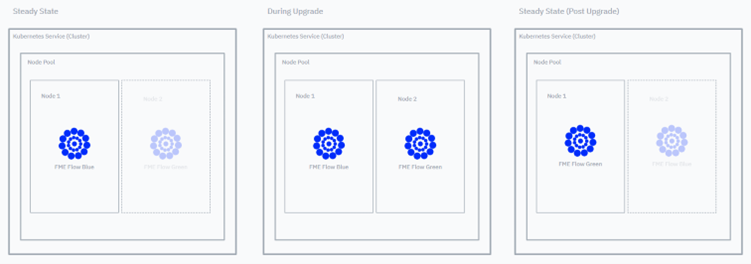
The old Blue environment can be kept running for a short period, acting as the ultimate safety net.
3. Instant Rollbacks: The Ultimate Safety Net
What if you discover an issue with the new Green version after the switch? No problem. Because the Blue environment is still running, rolling back is as simple as switching the traffic back to it. What used to be a frantic, multi-hour restoration process becomes a single, stress-free command that takes seconds.
Making the Move: How We Bridge the Gap to Kubernetes
While the benefits are clear, we understand that adopting Kubernetes and containerising FME Flow represents a significant technical shift. It requires a specialised skillset in cloud-native architecture, container orchestration, and network configuration. That's where we come in.
Our services are designed to guide you through every step of this modernisation journey, ensuring you reap the rewards of Kubernetes without the steep learning curve. We partner with you to:
- Architect and Deploy: We design and build a robust, scalable Kubernetes cluster tailored to your specific FME Flow workload, whether it's on-premise or in the cloud (AWS, Azure, GCP).
- Migrate Your FME Flow: We handle the entire process of containerising your FME Flow deployment, migrating your existing projects, schedules, and configurations with minimal disruption.
- Implement Modern Deployment Pipelines: We build the automation that makes Blue-Green deployments a reality for your team, transforming your upgrade process.
- Provide Managed Support: We don't just build it and leave. Our managed services offer ongoing monitoring, maintenance, and security for your FME Flow deployment on Kubernetes, so you can focus on your data, not your infrastructure. We’ll even manage the upgrades for you.
Beyond Upgrades: A More Resilient Future
The ability to perform quick, risk-free upgrades is a game-changer, but it’s just one of the many benefits. An FME Flow deployment on Kubernetes is also inherently more scalable, resilient, and resource-efficient. It’s a platform built for the future of data integration.
Additional Context: FME Flow, Kubernetes, and Cloud-Native Data Integration
FME Flow (formerly known as FME Server) is one of the most powerful platforms for automating and integrating both geospatial and non-geospatial data workflows. Deploying FME Flow within a Kubernetes environment enables UK organisations to embrace cloud-native, DevOps, and GitOps best practice - delivering consistency, scalability, and resilience across their data infrastructure.
Modern deployment techniques such as Blue-Green Deployments, Canary Releases, and container orchestration have transformed how teams manage FME Flow upgrades. By combining Safe Software’s FME with Kubernetes clusters on platforms such as AWS EKS, Azure AKS, or Google GKE, organisations can achieve near zero-downtime deployments, consistent configuration management, and fully automated rollback options.
This approach is particularly beneficial for UK-based data teams, local authorities, utilities, and environmental organisations who rely on uninterrupted data services. The key advantages include:
- Near Zero-downtime upgrades through intelligent traffic switching.
- Environment consistency between testing and production systems.
- Elastic scalability for heavy data workloads.
- Simplified maintenance through automation and orchestration.
- Future-ready infrastructure aligned with modern data standards.
FME Flow running on Kubernetes is also ideal for hybrid and on-premise deployments, supporting organisations with specific data sovereignty or compliance requirements common within the UK public sector and regulated industries.
For organisations embarking on this journey, working with experienced FME and Kubernetes consultants in the UK can accelerate migration, reduce operational risk, and ensure a seamless transition to containerised infrastructure.
FME Flow Kubernetes Architecture in Azure Kubernetes Service (AKS)
The architecture diagram below outlines an FME Flow deployment on Azure Kubernetes Service (AKS) with external service integrations and GitOps workflow management.
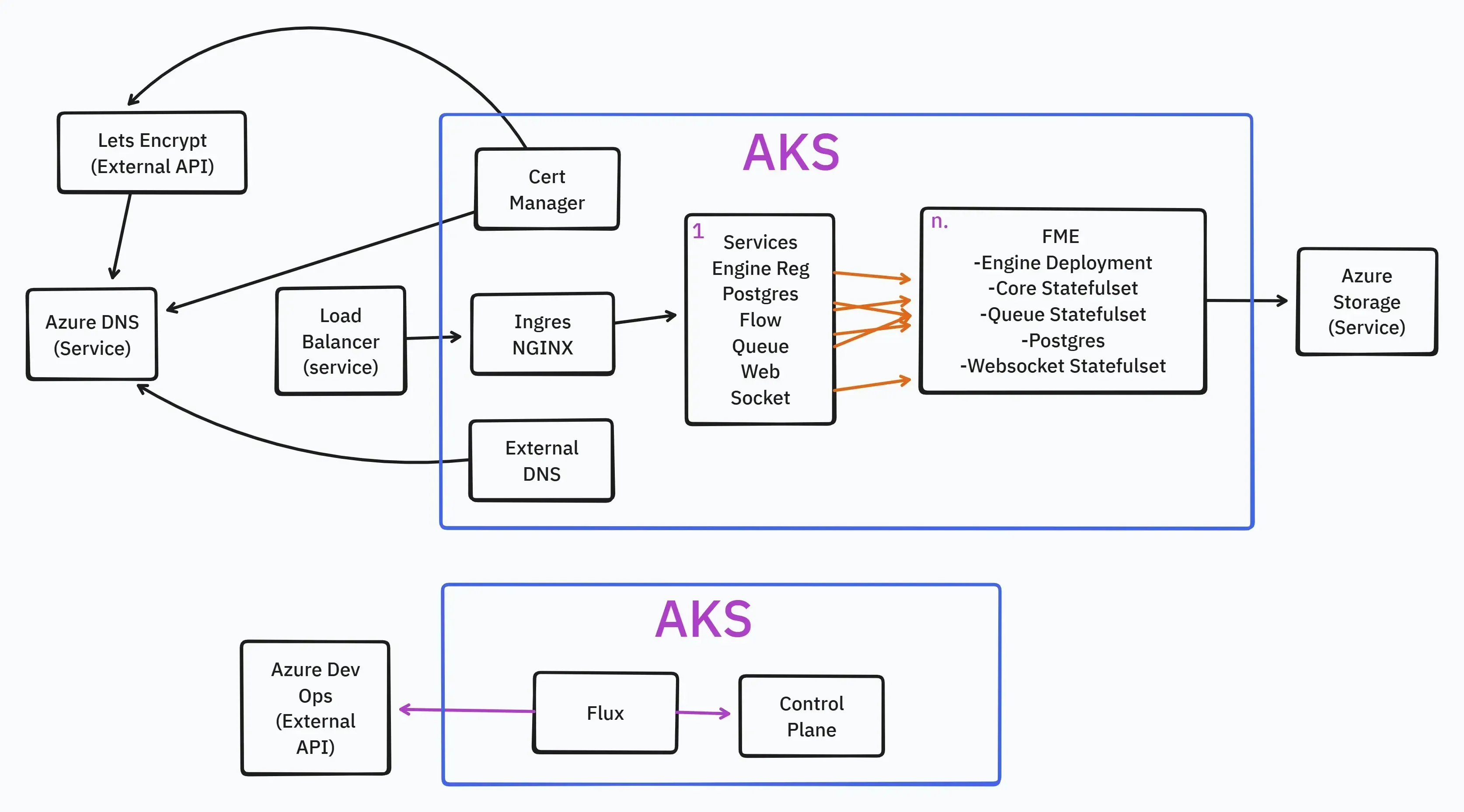
This diagram illustrates the Kubernetes-based infrastructure required to run FME Flow on Azure Kubernetes Service (AKS). The upper section depicts the production environment where external traffic flows through Let's Encrypt for SSL certificate management and Azure DNS for domain resolution, before reaching the Load Balancer service and Ingress NGINX controller. Within the AKS cluster, the Cert Manager handles certificate provisioning, whilst the Services Engine Registration, Postgres database, Flow Queue, Web interface, and Socket services connect to the FME component, which orchestrates Engine Deployment with Core Statefulset, Queue Statefulset, Postgres database, and Websocket Statefulset configurations. The FME component integrates with Azure Storage for persistent data storage. The lower section demonstrates the GitOps deployment strategy, where Azure DevOps manages continuous delivery through Flux, which synchronises with the AKS Control Plane to maintain the desired cluster state. This architecture provides a scalable, automated and resilient deployment pattern for FME Flow services in a cloud-native environment.
Quick Q&A: FME Flow and Kubernetes
Q: What are the main benefits of running FME Flow on Kubernetes?
A: It removes upgrade anxiety, enables near zero-downtime deployments, and provides improved scalability and reliability compared with traditional server setups.
Q: Can FME Flow on Kubernetes run within UK-based cloud services?
A: Yes. Many UK organisations successfully run FME Flow using managed Kubernetes services such as Azure Kubernetes Service (AKS) and Amazon Elastic Kubernetes Service (EKS), maintaining data residency within the UK.
Q: Is Kubernetes suitable for smaller FME Flow environments?
A: Absolutely. Kubernetes can be configured to scale up or down depending on the workload, making it suitable for everything from small departmental setups to large enterprise-scale deployments.
Q: How does this approach help UK public and private sector teams?
A: It supports digital transformation strategies, reduces IT overheads, and aligns with government cloud adoption frameworks, all while ensuring consistent access to mission-critical geospatial data services.
Q: Where can I find help with containerising FME Flow in the UK?
A: Specialist partners and consultants offer tailored support for FME Flow containerisation, Kubernetes deployment, and cloud migration - helping teams modernise infrastructure, optimise performance, and deliver reliable data integration services.
Ready to leave upgrade anxiety behind and unlock a more powerful, flexible FME Flow experience? Let's talk about what a modern deployment could look like for your organisation.


