

Managed Services for GIS and FME: Why AI bug detection changes the risk
I was sceptical at first
About a month ago I held off writing about Claude Mythos when the first wave of coverage appeared. Partly because there was a lot of noise around it and partly because claims about AI autonomously finding and exploiting software vulnerabilities at scale sounded a bit rich. AI is never short of dramatic headlines and I assumed there was at least some hype in the mix.
Now at the start of May that viewpoint has become much harder to maintain
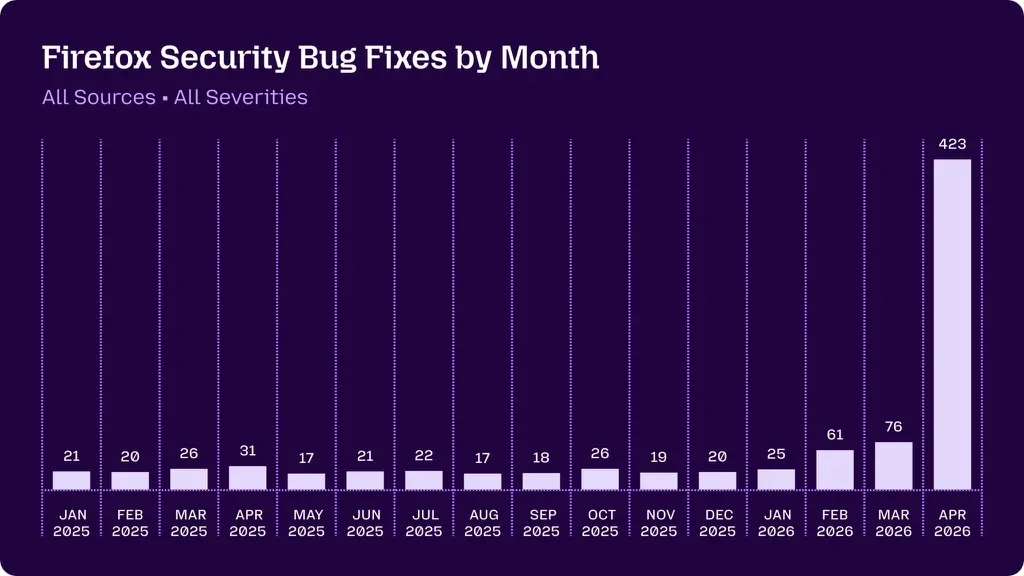
What changed my mind was not one headline on its own but the combination of things that followed. Mozilla published a detailed article on its bug fixing activities using a preview model in the Firefox security process, where Claude Mythos was reported to have surfaced 271 vulnerabilities and contributed to a spike of 423 Firefox security bug fixes in April.
The Financial Times also recently highlighted the wider point that this is not just about one model or one vendor. More capable cyber-focused AI systems are emerging quickly and the operational consequences are arriving before most organisations are ready. Such a focused AI system (https://xint.io/) a couple of weeks ago found a linux core vulnerability referred to as Copy Fail and proported to be 'The Worst Linux Privilege Escalation in Years'.
These are all pointing to the same thing. AI tools are now delivering tangible results in this area and this matters for every enterprise platform team and especially for organisations running geospatial infrastructure.
Why This Matters for GIS and FME Environments
GIS platforms do not sit in a siloed technical box, they are woven into wider operational estates. ArcGIS Enterprise environments typically connect into identity services, web applications, databases, APIs, internal systems and field workflows. FME environments often sit at the heart of integration, automation, data movement, validation and service orchestration.
In many organisations these platforms support processes that are business-critical and of course easy to take for granted until something goes wrong. That means the security issue is not simply whether a vulnerability exists, it's whether the organisation around the platform can detect, assess, prioritise, test and respond quickly enough when weaknesses are being surfaced much faster than before.
We have already seen recent critical security issues affecting ArcGIS Enterprise. Esri's April 2026 security bulletin addressed two critical Portal for ArcGIS vulnerabilities, CVE-2026-33518 and CVE-2026-33519, both carrying CVSS 9.8 (critical) scores. One related to incorrect privilege assignment in Portal for ArcGIS 11.5. The other related to incorrect authorisation checks for developer credentials in Portal for ArcGIS 11.4, 11.5 and 12.0.
The Patch Cycle Problem will quickly become an Operations problem
One of the most useful observations in the wider Mythos discussion is that vulnerability discovery will be speeding up faster than enterprise response processes and this has practical consequences.
Most organisations cannot simply push a patch into production the moment an issue is reported. They have to understand the impact, check dependencies, test integrations, coordinate changes, manage communications and make sure nothing else pops out of the woodwork. All of which is very time-consuming.
Now add AI to the other side of the equation
High-end models helping defenders find more issues is good news but the same general dynamic also means attackers, hostile researchers or state-backed teams may be able to identify weaknesses more quickly as well. Finding a flaw can become faster than remediating it safely. Indeed the linux Copy Fail bug even has its own webpage to get the exploit - https://copy.fail/
For organisations running complex GIS and FME estates that is the pressure point. The challenge is not only security tooling, it's operational readiness.
Why Managed Services Starts to Look Different in This Context
Managed services is sometimes discussed as if it is mainly about reducing headcount pressure or outsourcing routine administration but thats not the full story.
In this environment the value of managed services is that it creates an operating model better suited to continuous change, faster risk identification and more disciplined response. It gives organisations access to specialist expertise, a clearer route for service management and a more proactive approach to platform health, maintenance and improvement.
That is the context in which Avineon Tensing's Managed Services for Esri and FME environments should be understood. Our role is to act as a strategic extension of your team, that includes helping reduce operational burden, bringing in specialist Esri and FME expertise, monitoring platform health, supporting incidents and service requests and providing structured guidance around changes, upgrades, optimisation and security patching.
As Esri and Safe Software FME partners we also work closely with the platforms themselves, which matters when the pace of change and patching starts to pick up.
It also means giving organisations something many internal teams struggle to maintain on their own: continuity. People move on, priorities shift, internal teams get pulled in ten directions. Documentation is rarely as complete as everyone hopes. Bespoke integrations accumulate and over time even well-run environments become dependent on a small number of individuals who understand how everything hangs together.
What Good Managed Services Actually Looks Like
Good managed services is not a black box and it is not a vague promise to keep an eye on things. It should mean clear communication, defined service management, visibility of ongoing work, structured prioritisation and a team that understands both the platform itself and the business importance of the services it supports.
For geospatial environments it means:
- proactive monitoring of platform health and service performance
- specialist knowledge across ArcGIS Enterprise and FME environments
- access to a support desk with a real person at the end of the line
- a single point of contact across interconnected parts of the estate
- guidance on changes, updates, upgrades and patching
- clearer response routes when incidents or risks emerge
- reduced dependency on overstretched internal teams
At Avineon Tensing this is what we offer through our Managed Services solution and we support a range of industries in the UK and Netherlands with their Esri and FME environments.
Don't Panic
Human judgement, architecture discipline and operational maturity matter more when the pace of discovery increases. If anything AI raises the premium on organisations that know their environments well, keep them well-governed and are set up to act in an organised way when something needs attention.
It also raises the cost of technical debt. Messy environments, unclear ownership, brittle integrations and reactive support models were always risky, they're becoming a more expensive one.
There is always time to build out a well-governed solution and we are here to help.
To sum up with a key question
Picture a set of serious issues affecting your GIS or FME estate that emerge over a few consecutive days. How confident are you that your organisation could assess the risk they pose quickly, understand the dependencies, make the right changes and communicate clearly without disrupting critical services?
That is the question more organisations are going to have to answer in the months ahead and security patching turns from being a resourcing conversation to a system resilience conversation.
If this is a conversation your team is starting to have, we would be very happy to talk it through. You can also visit our Managed Services page to see more about how we support clients to protect their Esri and FME environments.
Official Esri April 2026 Security Bulletin: https://www.esri.com/arcgis-blog/products/trust-arcgis/administration/april2026_security_bulletin
Mozilla Firefox Claude Mythos Report (May 2026): https://hacks.mozilla.org/2026/05/behind-the-scenes-hardening-firefox/


