


Patchmageddon, Zero-Day Windows and the Open-Source volunteer risk
*This is not light reading, perhaps one for after your Summer holiday.*
From Early Warning to Operational Reality
In May I wrote a blog post about how AI-assisted vulnerability discovery was reshaping the risk profile for enterprise GIS and FME environments, prompted by early previews of Claude Mythos surfacing 271 Firefox vulnerabilities in a month and the Linux Copy Fail privilege escalation flaw. The core point was that vulnerability discovery was accelerating faster than enterprise response cycles. Two months on that trend has hardened into an operational reality with concrete numbers behind it, set out in JP Morgan's July 2026 report Patchmageddon: The race to patch software vulnerabilities before zero-day cyber-exploitations proliferate.
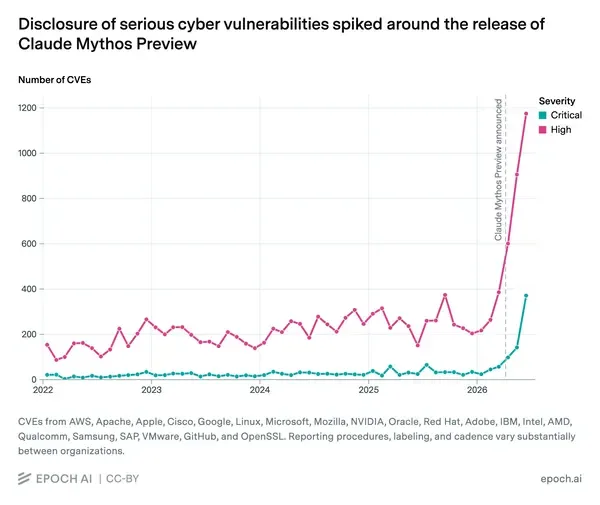
Take a look at the unprecedented volume in patches this year by Microsoft.
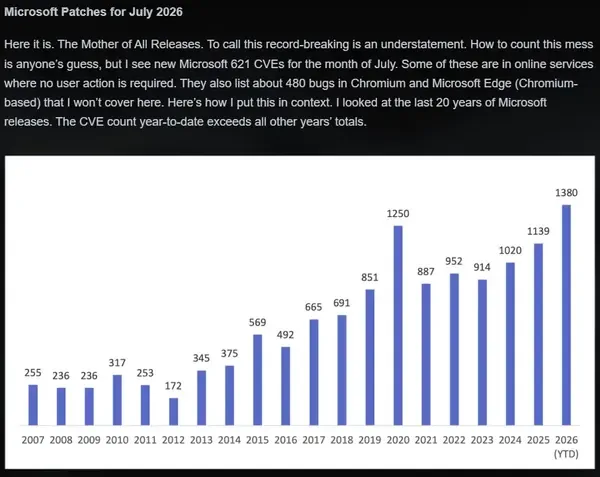
The Patchmageddon Data
JP Morgan Asset Management's Eye on the Market report authored by Michael Cembalest sets out where things stand:
- The median gap between a vulnerability's public disclosure (CVE) and its first active exploitation (Time-to-Exploit) has fallen to zero days. Automated attack scripts can exploit flaws within hours, sometimes before a vendor patch exists.
- Roughly 60% of corporate breaches occur when a patch was already available at the time of compromise.
- Project Glasswing data cited in the report shows frontier models surfaced over 10,000 high- and critical-severity zero-days in their first month of deployment; 95% had no public advisory at the time of discovery.
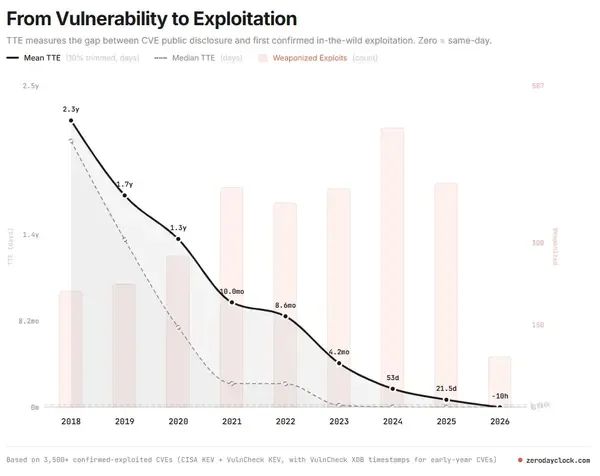
The report's central finding: the constraint is no longer a shortage of patches but human operational lag. Attackers move at machine speed; enterprise change control still moves in weeks.
The Open-Source Volunteer Problem
The report also examines the open-source maintainer base that underpins most enterprise software:
- 77–90% of a typical enterprise application's codebase is pre-built open-source code, averaging around 1,180 components per application.
- Over 18 million open-source projects rely on a single maintainer.
- Across the top 50 critical open-source projects, 136 individual developers are responsible for more than 80% of all code written.
- 45% of maintainers cite burnout as their primary challenge, working unpaid in their spare time.
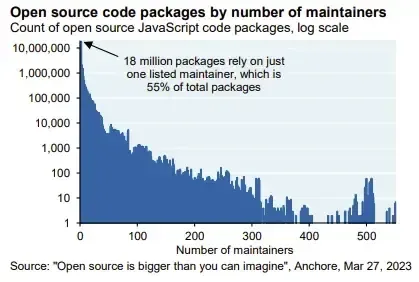
AI models are now scanning public repositories at scale. In one trial cited in the report, Anthropic identified 3,900 high or critical-severity open-source bugs; only 75 were patched, since maintainers lack the capacity to act on the volume. AI-driven discovery is outpacing human patching by roughly 16.5 to 1.
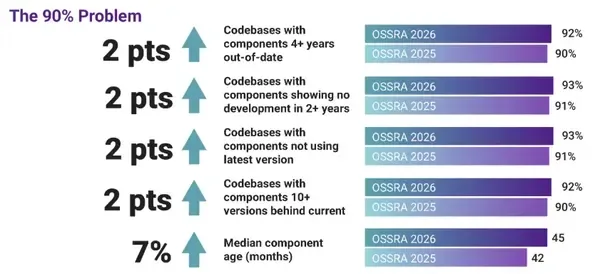
95% of open-source vulnerabilities sit in transitive (nested) dependencies - a typical JavaScript project pulls in an average of 683 nested packages via its direct imports, most invisible to the importing organisation. The median package is 278 days behind its latest major release. A zero-day found in a nested dependency maintained by one burned-out volunteer exposes every enterprise using that code, whether or not they know it's there.
Implications for ArcGIS Enterprise and FME Environments
ArcGIS Enterprise (Portal, Server, Data Store) and Safe Software FME Flow both depend on Python scripting, custom transformers, webhooks, database drivers and underlying open-source spatial libraries like GDAL. Three practical consequences follow:
- An environment can be fully current on vendor patches while custom Python scripts, FME transformers or third-party add-ons still pull in unpatched open-source dependencies.
- Patching quickly carries its own risk. Esri's June 2026 bulletin addressed CVE-2026-13019, a CVSS 9.8 authentication bypass in Portal for ArcGIS but an untested patch can break custom FME workflows or web services, while delay leaves the vulnerability open to automated scanners.
- Safe Software's FME 2026.2 introduces Security Tiers and removes embedded browser authentication, moving platform security toward continuous architectural hardening rather than periodic patching. Adopting these boundaries requires reviewing existing workspaces so automated routines don't silently fail.
Moving to Continuous Operational Readiness
This isn't solvable with tooling alone and it's quickly becoming a tall order for internal GIS teams already delivering day-to-day project work. It's where a managed services model earns its place.
Avineon Tensing's Managed Services for Esri and Safe Software FME environments are built around this:
- Live monitoring of system performance, geo-service health and automated threshold alerts to catch anomalies and dependency risk early.
- Support to stand up staging environments and pre-tested deployment pathways, allowing patches to be assessed and applied without disrupting live FME or ArcGIS services.
- Ongoing simplification of architecture and auditing of custom code, since undocumented environments with unmonitored scripts are the easiest targets for automated exploitation.
- Direct access to certified Esri and FME specialists and dedicated Service Managers, removing single-point-of-failure risk.
The question worth asking
If an AI-surfaced zero-day hits a critical dependency in your ArcGIS Enterprise or FME Flow estate on a Friday afternoon, does your team have the capacity, visibility and process to assess and patch it quickly?
If not, you're far from alone but as this reporting outlines the case for treating this as a priority rather than a background risk is increasingly hard to argue with.
References
- JP Morgan Asset Management (July 2026): Eye on the Market: Patchmageddon – The race to patch software vulnerabilities before zero-day cyber-exploitations proliferate, Michael Cembalest. [Full Report]
- Esri June 2026 Security Bulletin: Portal for ArcGIS Security Update 2, CVE-2026-13019 (CVSS 9.8). [Official bulletin]
- Safe Software: FME 2026.2 Security Hardening & Security Tiers. [Support Center]
To discuss how Avineon Tensing can help secure, simplify and manage your Esri ArcGIS Enterprise and Safe Software FME environments, contact Alex Taylor or visit our Managed Services page.


