


If you work in a council planning, FOI or complaints team, you may have noticed it already: the letters are getting longer, more legal-sounding and more frequent.
In August The Economist put the problem on its cover. Its leader, 'How AI is breaking the British state', argues that citizens using AI to file objections, appeals and claims will 'overwhelm bureaucracies built for the age of the post and the telephone'. It reports that the backlog in employment tribunals has risen by 55% in a year, in large part due to AI-fuelled claims, and that demand for emergency injunctions has surged 100-fold. On planning it is blunt: a regime 'paralysed by AI objections' risks getting nothing built at all.
That's the headline. The evidence underneath it is now available too.
From anecdote to evidence
A new paper co-authored by the Oxford-based Centre for the Governance of AI (GovAI) gives the problem its name: agentic flooding of government services. They define it as a surge in the volume or complexity of requests, caused by AI, that substantially strains a public service.
They screened 2,288 candidate services and identified 84 cases across 11 jurisdictions and 13 service domains. In 69% the government body itself blamed AI, and in 87% the mechanism was LLM-written text.
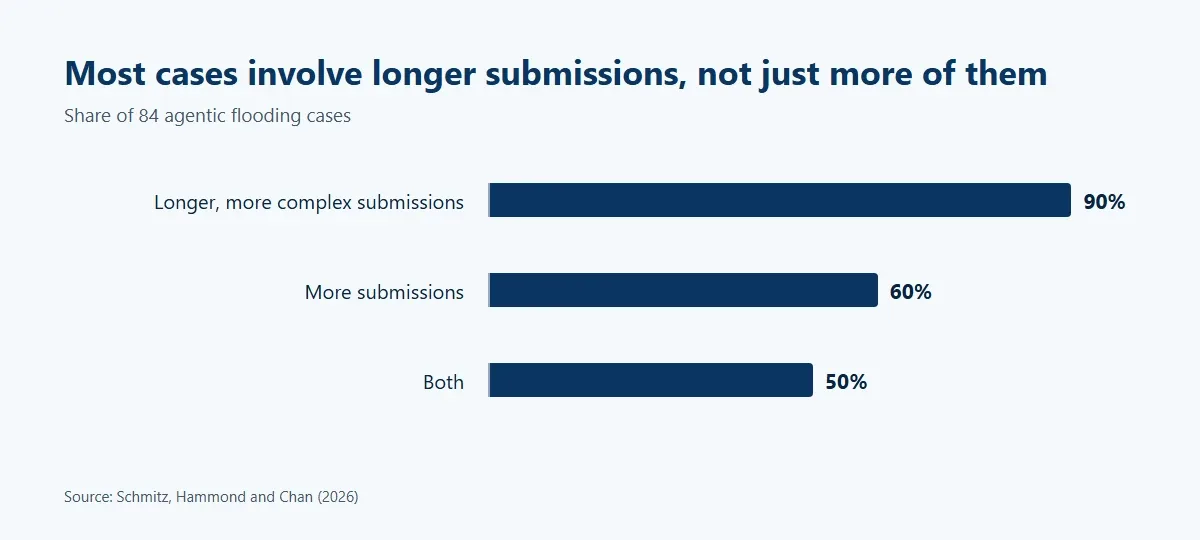
Some of the examples are striking. German social courts largely attribute a 55% year-on-year rise in caseload in 2025 to AI-generated claims, with some submissions running past 4,000 pages. Australia has considered bringing back FOI fees in response to a wave of AI-written requests. Closer to home, UK cases include Local Plan consultations, Money Claims Online and Housing Ombudsman complaints.
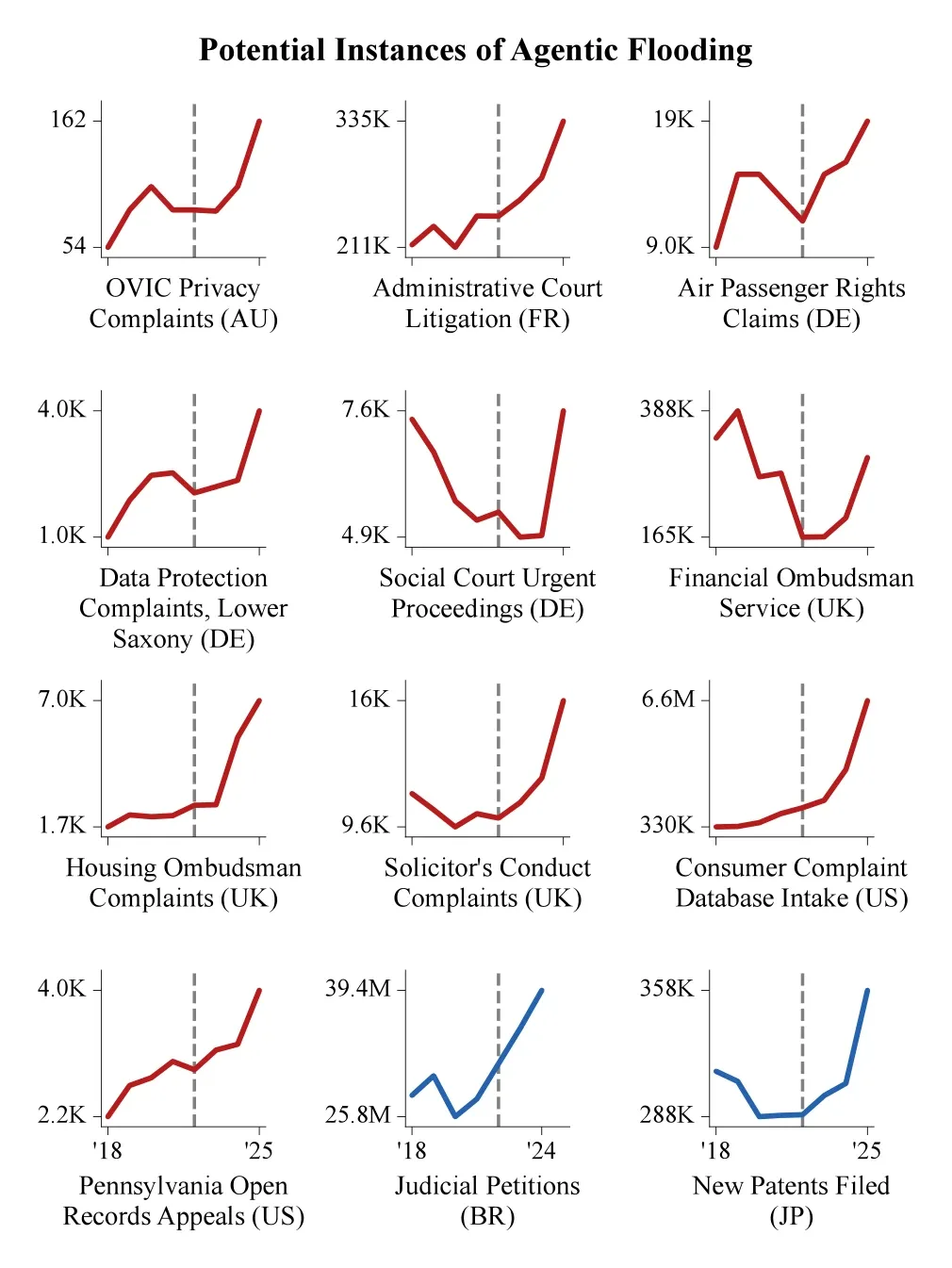
The authors are careful to say their method doesn't support causal or quantitative claims; only 25 of the cases have time-series data at all. But when dozens of independent bodies in different countries point at the same cause, it's worth paying attention.
Why councils are exposed
The paper's risk matrix scores 13 factors: five that make a flood more likely and eight that make it more severe. The authors rate risk highest for financially attractive services where complex paperwork has historically held demand down, such as court claims and tax returns.
Most council services are less lucrative than a tax rebate, but stopping an unwanted development next door is a strong incentive in its own right. And several council services score badly on the factors that decide whether a flood can be absorbed:
| Risk factor in the paper | What it looks like in a council |
|---|---|
| Susceptible service interface | Consultation portals, FOI inboxes, complaint forms and objection letters accept text of almost any length |
| Effort required to submit, and the gap between assumed and full take-up | Writing a coherent objection or formal complaint used to take time and know-how, which quietly capped volumes. An LLM removes that in seconds |
| Processing effort mandated by law | Statutory response times, consultation duties and the right to a reasoned answer mean the pile can't be skimmed |
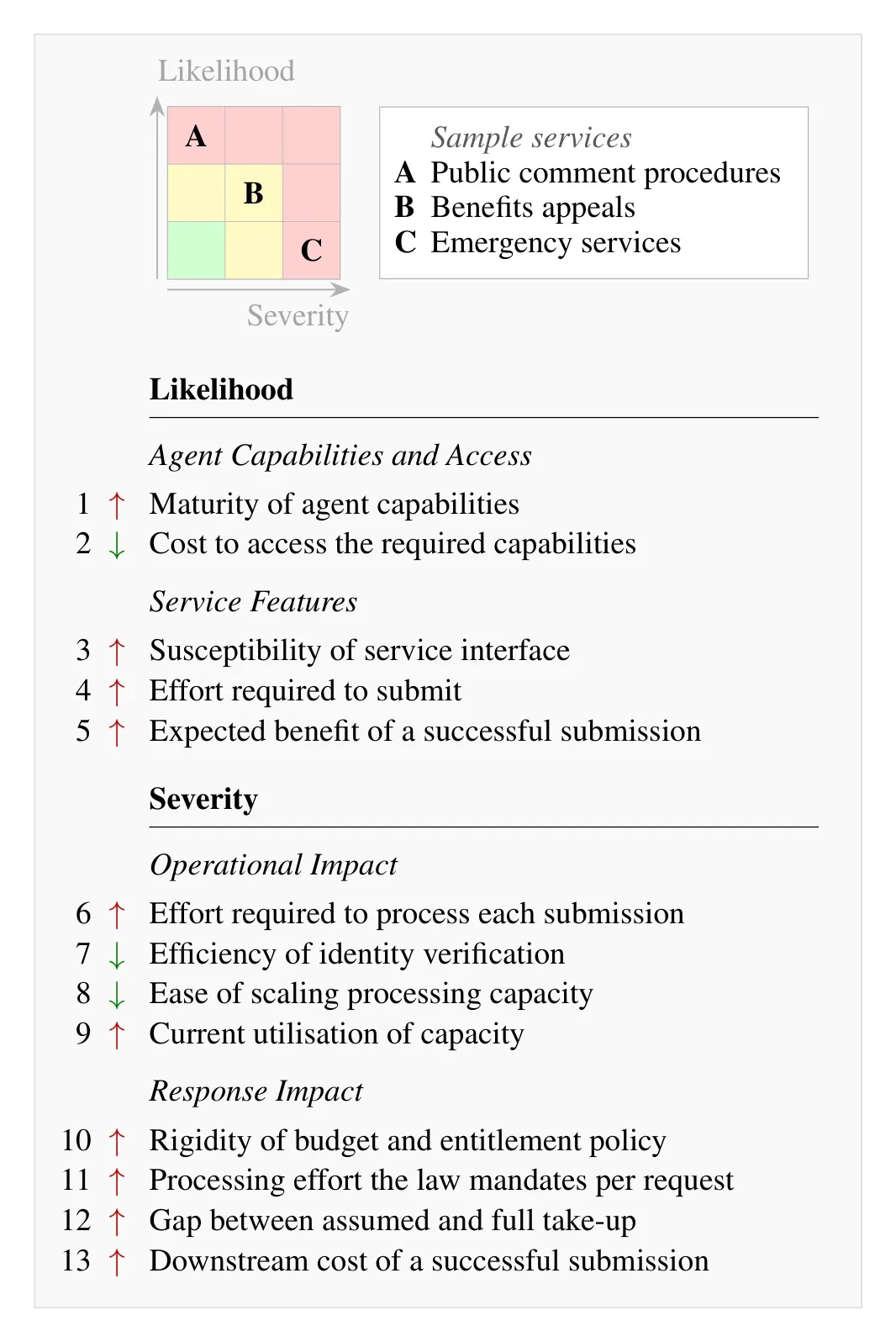
Add budgets that assume historic take-up and teams already running close to capacity, and the headroom disappears quickly.
In principle this is a good thing. The Economist calls it 'a cracking result for fed-up citizens': the poor could exercise their rights as successfully as the sharp-elbowed middle classes do today. The problem is the processing side, which hasn't changed. And it will get harder. Officials complain about AI 'slop' today, but as models improve they will face 'demands as well-crafted as a first-class lawyer's'. Filtering out the weak submissions won't be enough.
The quick fix has a cost
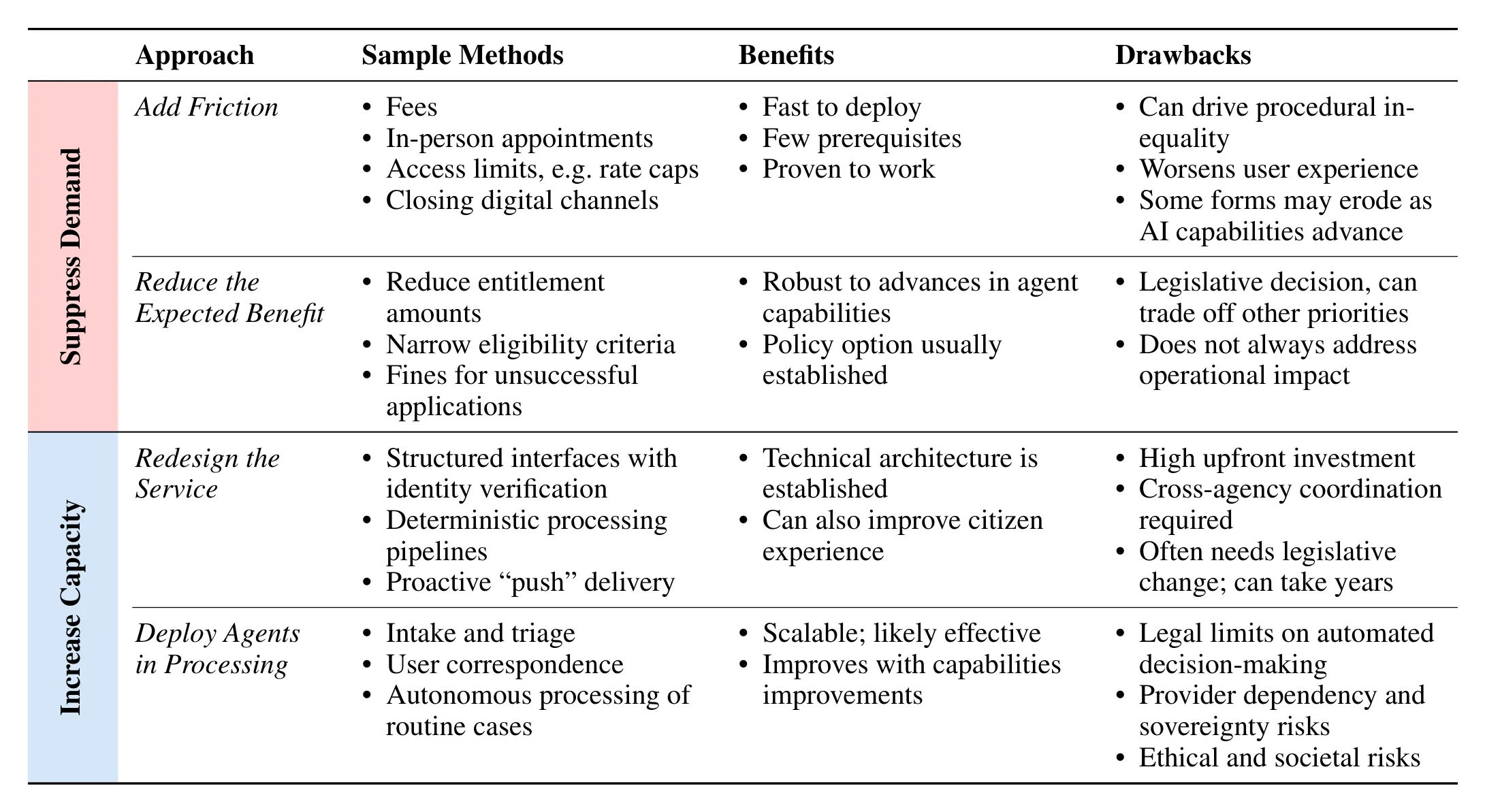
The paper sorts government responses into two strategies. One suppresses demand, by adding friction or reducing the benefit of applying. The other increases capacity, by adding staff, redesigning the service or using AI in processing.
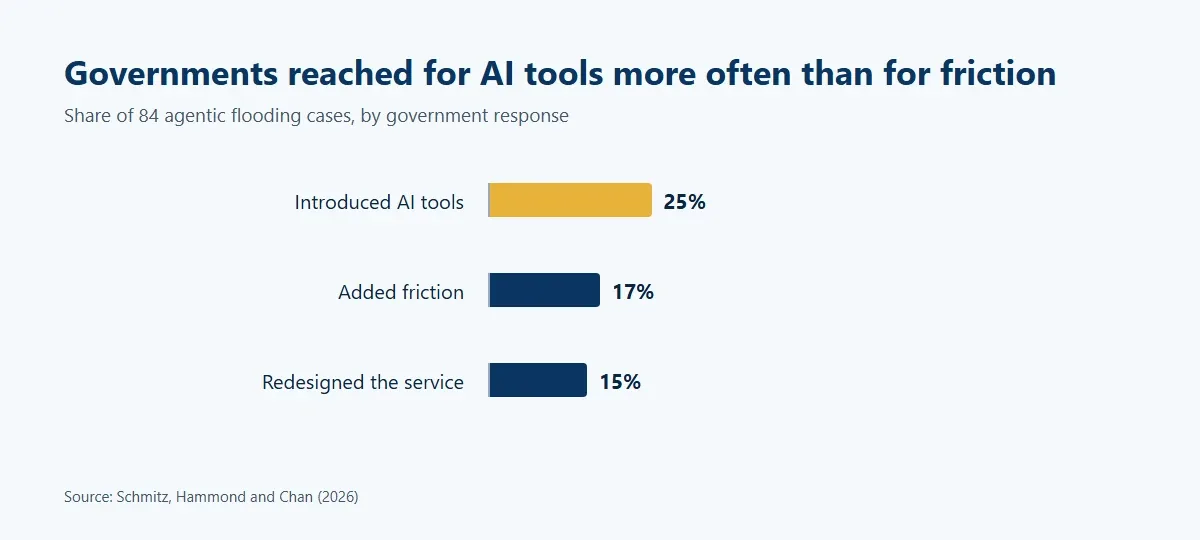
Governments responded in just over half of the cases. Friction measures (fees, rate limits, identity checks, IP blocking) appeared in 17%. Japanese authorities blocked consultation submissions by IP address, and some bodies batch-dismissed responses.
The Economist leans the same way. It proposes pruning procedural rights, charging for FOI requests 'as other countries do', bringing fees to employment tribunals and creating fewer entitlements that are 'ripe for AI-fuelled claims'.
These measures work, and they're quick. But they hit poorer, less digitally confident and more vulnerable residents hardest, and they throw away the accessibility gains AI offers. Capacity building avoids that trade-off but needs lead time, which is why the authors want work to start before a surge, not during one.
Interestingly, The Economist ends up in the same place. It calls the most important task 'remaking the state with AI', including a planning system that could check for itself whether a housing development meets the zoning code. We'd keep the decision with officers. But building processing capacity before the surge is the right direction, and that's where we can help.
Meeting AI-written requests with well-governed AI
In a quarter of the paper's cases (21 of 84), governments introduced AI tools in response, more often than they added friction. One is a UK planning case: for Local Plan consultations, officials brought in AI to analyse sentiment across large numbers of public comments. Bounded tools like this, handling one step with a human in the loop, are the sensible place to start.
We've been building exactly these kinds of pipelines, and they're already in use:
| Capability | What we've built | Council use |
|---|---|---|
| Planning document intelligence | Around 700 spatial planning documents for a group of Dutch municipalities, indexed page by page. Search by meaning, place names resolved to geometry, maps inside PDFs searchable, zoning by address, all queryable by AI assistants through MCP | Link every consultation response to the site or policy it concerns |
| Semantic search | Semantic FME Insights turns thousands of files into a plain-English searchable index, re-indexing incrementally as new material arrives | Group near-duplicate and templated submissions; find precedent |
| Document extraction | Labs apps using computer vision and generative AI to pull tables from PDF reports into structured data | Turn long attachments into structured, reviewable data |
Point the same pattern at a consultation inbox and the picture changes. Every response is read, tagged by theme and sentiment, and linked to the site or policy it's about. Templated submissions are grouped, and the distinct, well-argued points are pulled out rather than lost in the volume. Officers start from a map and a ranked summary, not a 4,000-page letter.
Two principles we hold to, given the public-sector context:
| Principle | What it means |
|---|---|
| No black box | We hand over the workflows with documentation and mentor your team to run and change them |
| Your data stays yours | Runs on Gemini, OpenAI or a local LLM in your own infrastructure, with no external API calls if needed |
Three things councils can do now
The paper makes three recommendations that don't depend on predicting how fast AI moves. We'd frame them for councils like this:
| Action | What it involves | Why it matters |
|---|---|---|
| Audit your exposure | Score services on free-text input, suppressed demand, statutory processing duties and budget headroom | A short list of services to prepare first. We can run this with your team |
| Strengthen the front door | Identity verification and structured forms, pre-filled with data you already hold | Makes per-person rate limits enforceable and industrial-scale submissions harder, without penalising genuine residents |
| Get clarity on what's lawful | Review fees, channel restrictions and AI-assisted processing against administrative and AI law | Removes a barrier to acting early |
The question worth asking
If your next Local Plan consultation drew five times the usual responses, many of them long and AI-written, would your team still meet its statutory deadlines without closing the door on residents?
If not, you're far from alone. But the time to build that capacity is before the surge, not during it.
References
- Schmitz, C., Hammond, L. and Chan, A. (2026). Characterizing Agentic Flooding of Government Services. To appear in Proceedings of the 9th AAAI/ACM Conference on AI, Ethics and Society (AIES). arXiv:2608.16603. Dataset
- The Economist (2026). How AI is breaking the British state. Leader, 6 August 2026.
- Avineon Tensing: Semantic FME Insights
- Avineon Tensing: FME Labs
- Avineon Tensing: G-Cloud 15 services for the public sector
Get in touch with us
To talk about preparing your council's services for AI-driven demand.


